
Hip pain has a way of creeping into everything. It’s there when you get out of the car, when you climb the stairs, when you try to sleep on your side, and when you finally sit down at the end of the day. If you’ve been searching for dry needling for hip pain in Limerick or Charleville, you’ve probably already tried rest, stretching, or waiting it out, and you’re looking for something that gets to the source of the problem.
At Don Kelly Pain Relief, with clinics in Dooradoyle, Limerick and Charleville, Co. Cork, dry needling is one of the most effective tools we use for stubborn hip pain, particularly when tight, overactive muscles are driving the problem.
This article explains what dry needling is, which hip conditions it can help with, what a session feels like, and why it works best as part of a complete treatment plan.
What Is Dry Needling?
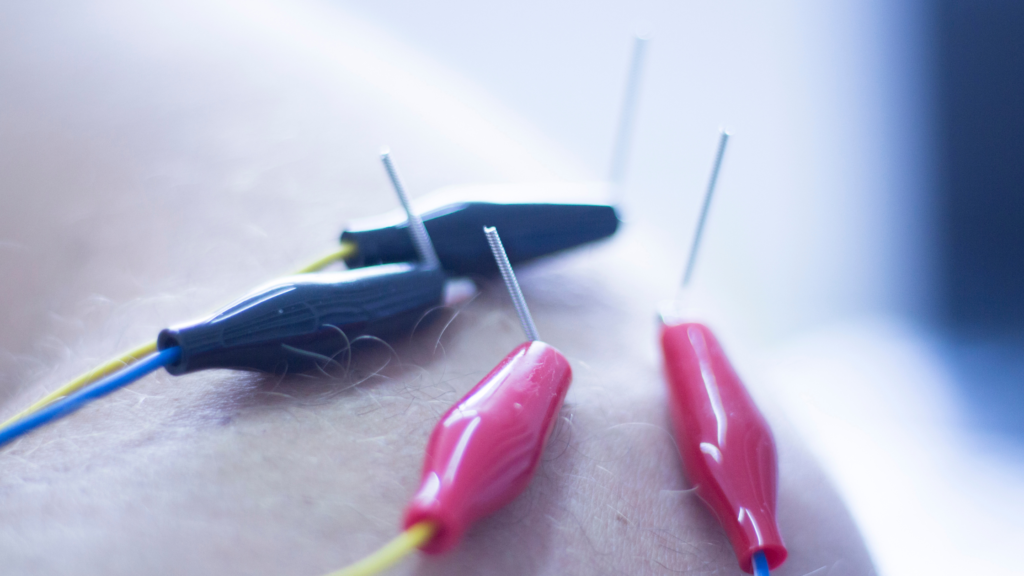
Dry needling uses very fine, sterile, single-use needles inserted into specific points in a muscle known as myofascial trigger points. These are tight, sensitive knots within a band of muscle that can cause local pain, refer pain to other areas, and stop the muscle from working properly.
When the needle reaches a trigger point, the muscle often produces a small twitch response. That twitch is a good sign. It indicates the muscle is releasing, which can reduce tension, improve blood flow to the area, and calm down the pain signals coming from it.
It’s called “dry” needling because nothing is injected. The needle itself does the work.
Why Dry Needling May Be Considered for Hip Pain
The hip is surrounded by some of the largest and most hard-working muscles in the body. Many of them sit deep beneath the surface, where massage and stretching struggle to reach. Dry needling allows a physiotherapist to target these deeper muscles directly.
The muscles we most commonly treat for hip pain include:
- Gluteus medius and gluteus minimus, the key stabilisers on the side of the hip. Trigger points here are a very common cause of pain on the outside of the hip, and gluteus minimus can refer pain down the side of the leg in a way that is often mistaken for sciatica.
- Piriformis, a small deep muscle in the buttock that can irritate the sciatic nerve when it becomes tight.
- Tensor fasciae latae (TFL), at the front and side of the hip, which often overworks when the glutes are weak.
- Iliopsoas, the main hip flexor, which tightens up in people who sit for long periods.
- Quadratus lumborum, a lower back muscle that frequently contributes to pain felt around the hip and pelvis.
Hip Conditions Dry Needling Can Help With
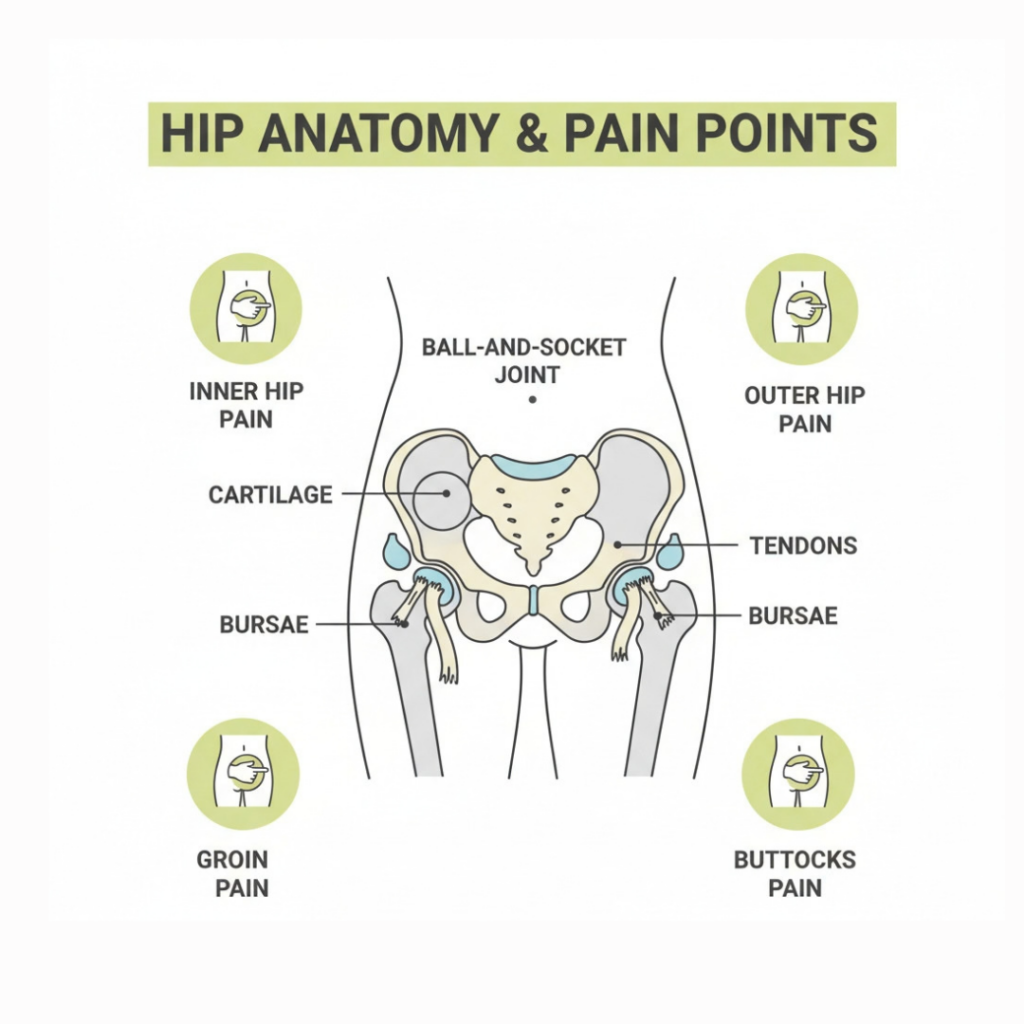
Dry needling isn’t a one-size-fits-all treatment, and a proper assessment always comes first. That said, it can be very useful for:
Lateral hip pain (greater trochanteric pain syndrome). Pain on the outside of the hip, often worse lying on that side at night, is one of the most common complaints we see at both our Limerick and Charleville clinics. It frequently involves the gluteal tendons and the muscles around them.
Piriformis syndrome and deep buttock pain. A deep ache in the buttock, sometimes with pain or tingling travelling down the leg, can come from a tight piriformis and surrounding muscles.
Hip flexor tightness and strain. Common in runners, footballers, hurlers and people who spend long hours at a desk or behind the wheel.
Muscle tension around hip osteoarthritis. Dry needling doesn’t change the joint itself, but the muscles around an arthritic hip often tighten up to guard it. Easing that tension can reduce pain and make it easier to move and strengthen the hip.
Hip pain that’s really coming from somewhere else. Referred pain from the lower back or deep gluteal muscles is extremely common. Part of our job is working out whether the hip is actually the problem.
What Does the Research Say?
Research suggests that dry needling may provide short-term improvements in pain and physical function for some people with hip-related conditions. However, results vary depending on the diagnosis, and the available evidence is still developing.
A 2024 systematic review reported potential benefits for hip pain and function, while an earlier review of hip and knee osteoarthritis rated the available evidence as very low quality and called for further research. Therefore, dry needling should be considered one possible part of an individual treatment plan rather than a guaranteed solution.
What to Expect at Your Appointment
Every first visit starts with a thorough assessment. With over 27 years of clinical experience, Don takes the time to understand how your pain started, what makes it better or worse, and how it’s affecting your daily life. We’ll assess your movement, strength, posture and the muscles around the hip and lower back to find the root cause rather than just chasing symptoms.
If dry needling is suitable for you, we’ll explain exactly what we’re treating and why. The needles are extremely fine, much thinner than those used for injections, so most people feel very little on insertion. You may feel a dull ache or a brief twitch in the muscle, which usually settles within seconds.
After treatment, it’s normal to feel some mild soreness in the area, similar to the feeling after a workout, for a day or two. Many people notice easier movement and less pain soon after, though the number of sessions needed varies from person to person.
Dry Needling Works Best as Part of a Complete Plan
Dry needling can reduce pain and release tight muscles, but on its own it rarely fixes the reason those muscles tightened up in the first place. Weak glutes, poor movement patterns, long periods of sitting, foot mechanics and training errors all play a part in hip pain.
That’s why dry needling at our clinics is always combined with:
- Targeted exercise to strengthen the hip and restore proper control
- Hands-on physiotherapy to improve joint movement and soft tissue flexibility
- Advice on daily habits, including sleeping position, sitting posture and activity levels
- Assessment of foot mechanics and orthotics where your walking pattern is contributing to the problem
Our approach is simple: find the root cause, treat it properly, and help you avoid surgery wherever possible.
Dry Needling for Hip Pain in Charleville and North Cork
Our Charleville clinic offers the same assessment and treatment as our Limerick clinic, so people in Charleville, Kilmallock, Buttevant, Newcastle West and the surrounding North Cork and County Limerick areas don’t need to travel into the city for expert care. Whichever clinic you choose, you’ll be treated by Don directly, with the same root-cause approach and the same focus on long-term results.
Dry Needling Frequently Asked Questions
Most people feel very little when the needle goes in. A brief ache or twitch in the muscle is common and passes quickly.
It depends on your condition and how long you’ve had it. Some people notice a difference after one or two sessions, while longer-standing problems usually need a course of treatment alongside exercise.
No. You can book directly with us.
Whichever is more convenient. Both our Limerick, Dooradoyle and Charleville clinics offer dry needling for hip pain, and the treatment is the same at each.
Book Dry Needling for Hip Pain in Limerick or Charleville
If hip pain is stopping you from sleeping well, walking comfortably or doing the things you enjoy, you don’t have to put up with it. Don Kelly is a CORU-Registered Physiotherapist with over 26 years of experience helping people across Limerick, Charleville and North Cork get to the root of their pain.
Book your appointment today:
📞 086 323 9194
✉️ don@donkellypainrelief.com
Limerick clinic: 8 The Stables, Huntsfield, Dooradoyle, Limerick, V94 A5X6
Charleville clinic: Unit 2 Tahilla House, Balls Lane, Charleville, Co. Cork, P56 NW81