

Why a desk job is doing more to your hips than you realise, and what actually reverses it
Most people picture posture problems showing up in the back or neck. Far fewer realise that one of the most common drivers of chronic back, hip, and even knee pain starts at the front of the hip, in a small group of muscles called the hip flexors.
If you spend your day at a desk, behind the wheel, or on the couch in the evening, there is a good chance these muscles have already begun to shorten and tighten without you noticing, until the pain shows up somewhere else entirely.
What the Hip Flexors Actually Do (And Why They Cause Hip Pain)
The hip flexor group, primarily the psoas major, iliacus, and rectus femoris, connects your lower spine and pelvis to the top of your thigh bone. Every time you lift your knee, climb stairs, or take a stride while walking, these muscles are doing the work. They are also among the few muscle groups in the body that stay in a shortened position for hours at a time the moment you sit down. As the NHS notes on hip pain, muscle and joint causes are among the most common reasons hip pain develops, which is exactly why the hip flexors deserve closer attention.
Why Sitting Is the Problem
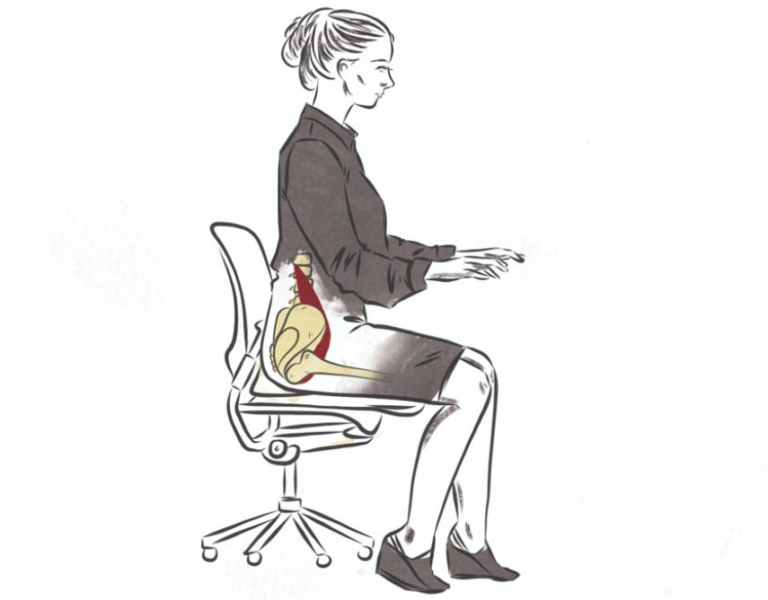
Muscles adapt to the position they spend the most time in. When the hip is bent at roughly 90 degrees for eight, ten, or twelve hours a day, the hip flexors gradually shorten through a process called adaptive shortening. Over weeks and months, this creates a few predictable, and largely invisible, changes:
- The psoas and iliacus lose length and become chronically tight, pulling the front of the pelvis downward and forward.
- This tilts the pelvis into an anterior tilt, which arches the lower back and increases compressive load on the lumbar spine.
- Tight hip flexors reciprocally inhibit the glutes, meaning the brain reduces activation in the very muscles that should be stabilising the hip and spine.
- The lower back and hamstrings are left to compensate for glutes that are switched off, which is a common, overlooked driver of recurring low back pain.
None of this requires an injury. It is a slow, cumulative postural change, which is exactly why it is so often missed until it has already contributed to months or years of pain.
Where Hip Pain From Tight Hip Flexors Actually Shows Up
Because the hip flexors influence pelvic position, spinal load, and glute function all at once, the pain they cause rarely presents at the hip itself. In clinic, the most common downstream patterns are:
- Chronic lower back pain and stiffness, particularly first thing in the morning or after standing up from a desk.
- Sciatic-type referral down the buttock and leg, driven by piriformis or glute compensation rather than true disc pathology.
- Anterior hip pinching or a “catching” sensation when standing up quickly or extending the leg behind you.
- Altered gait and uneven loading through the knees and feet, which is where custom orthotics often become part of the solution.
- Reduced stride length and a feeling of stiffness during exercise, even in people who consider themselves otherwise fit.
Why Stretching Alone Rarely Fixes It
A daily hip flexor stretch is a reasonable habit, but on its own it is rarely enough to undo years of adaptive shortening. Stretching lengthens a muscle temporarily; it does not restore glute activation, correct an anterior pelvic tilt, or release the deep fascial tension that builds up in the psoas over time.
This is why so many people stretch consistently and still feel tight by the following afternoon. Lasting change requires addressing the muscle directly, retraining the muscles around it, and correcting whatever mechanical factors, including footwear and gait, are reinforcing the pattern in the first place.
How We Treat It at Don Kelly Pain Relief
With over 26 years of clinical experience as a Chartered Physiotherapist, Acupuncturist, and Certified Dry Needling Practitioner, Don Kelly takes a layered approach to hip flexor dysfunction rather than treating it as a single, isolated tight muscle.
- Dry needling: directly releases trigger points deep in the psoas, iliacus, and rectus femoris that manual stretching cannot reach, restoring length and reducing referred pain quickly.
- Hands-on physiotherapy: rebalances pelvic position and reactivates the glutes, addressing the compensation pattern that stretching alone leaves untouched.
- Custom orthotics: correct the gait and loading imbalances that often develop alongside tight hip flexors, taking pressure off the hips, knees, and lower back with every step.
- A structured, progressive plan: built around your specific posture, occupation, and activity level, not a generic stretching handout.
This combination, manual therapy, dry needling, and biomechanical correction through custom orthotics, is precisely why patients across Limerick and Cork trust Don Kelly Pain Relief as the clinic of choice for chronic pain that other approaches haven’t resolved.
Find Out What's Really Driving Your Pain
If you sit for most of your working day and deal with recurring back, hip, or knee discomfort, the cause may be a hip flexor pattern that has been building for years. A proper assessment can identify exactly what is tight, what is weak, and what is compensating, and build a plan to fix it at the source.
Take Back Your Mobility
Contact Don Kelly Physiotherapy and Acupuncture today to schedule a comprehensive assessment. Let’s get to the root of your sciatica and bulging disc to build a customized plan to get you moving comfortably again.